Why Most Ocean Ingredients
Are Still Stuck
The ocean covers 70% of the earth. It’s one of the most underutilized ingredient sources in nutrition and health. Omega-3 proved it could scale. Marine collagen followed. After that, the list of commercially successful ocean ingredients gets short.
That’s not a science problem. The research behind algae, astaxanthin, sea moss, spirulina, and fucoidan is solid. The sustainability narrative is compelling. Consumer interest in natural, ocean-derived nutrition is real and growing. So why are most ocean ingredients still niche?
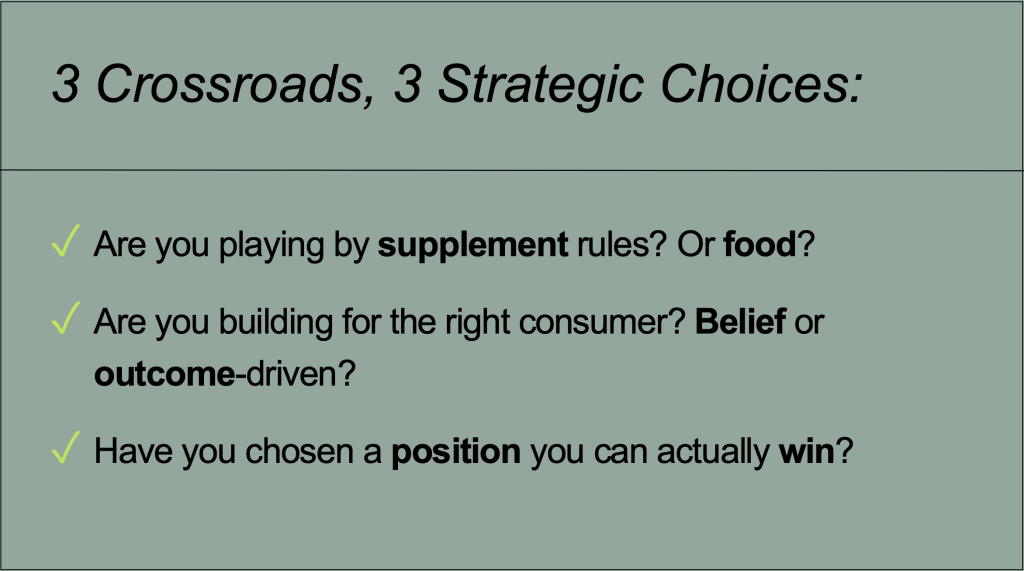
Because most brands, and most ingredient companies, face three critical strategic crossroads on the way to market. And most of them pick wrong.
The Three Crossroads
That Decide Commercial Success
Crossroads #1: Supplement or food? Not all ocean ingredients are playing the same game.
This is the first decision most brands underestimate, and it’s not just a format question. The rules are completely different. You could categorize them like:
Functional ocean ingredients like omega-3, marine collagen, astaxanthin, are positioned on a specific, proven health benefit. The source is secondary. The outcome is everything. The consumer question is: “What does this do for me?”
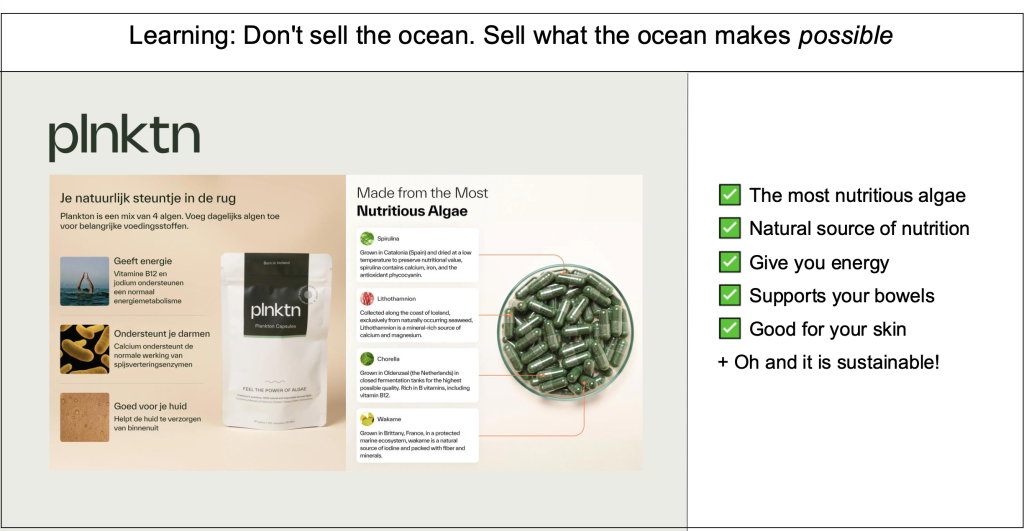
Ocean vegetables like spirulina, chlorella, sea moss, seaweed are plant-derived ingredients from the sea. They require cultural familiarity, sensory acceptance, and a food occasion to work. The consumer question is: “Do I know what to do with this?”
The failure mode is clear: sea moss and spirulina are consistently positioned as supplements without supplement logic. No clear ownable benefit. No felt outcome the mass market consumer can recognise before they buy. The result: a vague promise that requires belief. And belief doesn’t scale.
Omega-3 worked because the logic was airtight: a dietary gap most people already felt, a tangible and widely understood benefit (heart and brain health), and a source that made intuitive sense. Clear benefit + need + proof.
But supplement logic has evolved. Consumers today take supplements for two distinct reasons: to fill a gap they recognize, or to boost a function they want: better focus, gut health, recovery, cellular protection. The second group isn’t thinking in deficiency terms at all. They’re optimizing.
The real question is: what job is the consumer hiring this product to do?
The Key Learning: Early adopters buy the ingredient. The mass market buys the outcome. If the benefit requires explanation, it requires belief. Belief doesn’t scale.
Crossroads #2: Early adopter or mass market? Different needs, different messages.
New ingredients tend to attract early adopters first, consumers who curious, belief-driven, open to new ingredients. They read labels, follow health influencers, and will try sea moss because it’s interesting. Sustainability lands here. Novel ingredients land here.
Three consumer trends are giving ocean ingredients a moment right now with this group: longevity (performing better today, not just living longer), detox anxiety (microplastics, heavy metals, toxic load), and simplification (complete, real nutrition, one product, one routine, done).
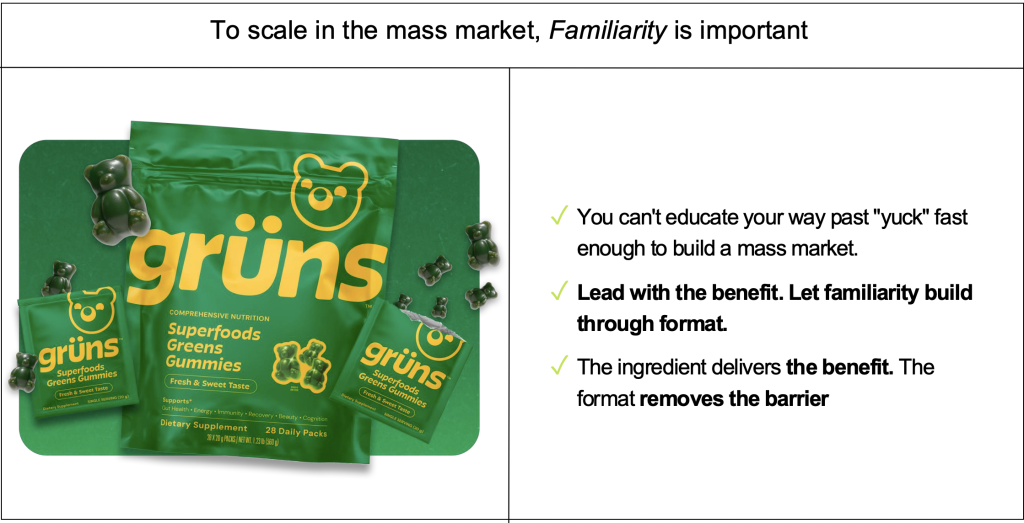
The mass market is a different consumer entirely. Outcome-driven, familiarity-seeking, skeptical of anything new. They care less about where the ingredient comes from. They care what it changes. And they are driving the simplification wave.
Marine collagen crossed from early adopter to mass market by making the source invisible and the benefit everything. The format did the rest.
The brands that fail at this transition lead with sustainability or ingredient novelty to a mainstream audience, speaking the early adopter’s language to a consumer who never asked for it. Sustainability gets attention. Value drives decisions.
The Key Learning: Early adopters validate your ingredient. The mass market scales your business.
Crossroads #3: Positioning vs Competition.
The moment you choose a position, you choose your competition.
You don’t compete based on your ingredient. You compete based on how you position it. The market will always place your ingredient in a category, compare it to existing benchmarks, and evaluate it on category rules. You only get to choose who you compete against.
The positioning trap — algae as protein: Competing against whey, pea, and soy. Evaluated on grams of protein per euro, taste, and familiarity. Algae loses every time. Not because the science is wrong, because someone made the wrong positioning call.
Same ingredient. Completely different commercial reality. Every positioning choice creates a competitive set. Make sure yours is one you can win.
The Key Learning: Positioning is not a communication decision. It’s a competitive strategy. Every positioning choice creates a competitive set. Make sure yours is one you can win.
The Three Strategies That Change That
The three crossroads explain why most ocean ingredients stay stuck. But there’s a second part to this story: the three strategies that turn ocean ingredient potential into market reality. Those are in the full presentation with brand examples, positioning maps, and the complete strategic framework.
Download the presentation here: